
2D Vector Velocity & Kinematics Calculator
Decompose velocity magnitude (speed) and direction (angle) into X and Y orthogonal components.
Last reviewed by the myCalculator Editorial Team
Input Parameters
Calculation Results
Next: related Physics calculators
Ohm's Law & Electrical Power Calculator
Solve electrical circuits for Volts, Amperes, Ohms, and Watts.
Bank Angle, G-Force & Stall Speed Calculator
Compute aerodynamic load factor Gs, accelerated stall speed increase, and turn radius for coordinated turns.
High Altitude Hypoxia & TUC Calculator
Determine Time of Useful Consciousness (TUC) window, ambient barometric pressure, and aviation oxygen regulations by altitude.
Formula & How 2D Vector Velocity & Kinematics Calculator Works
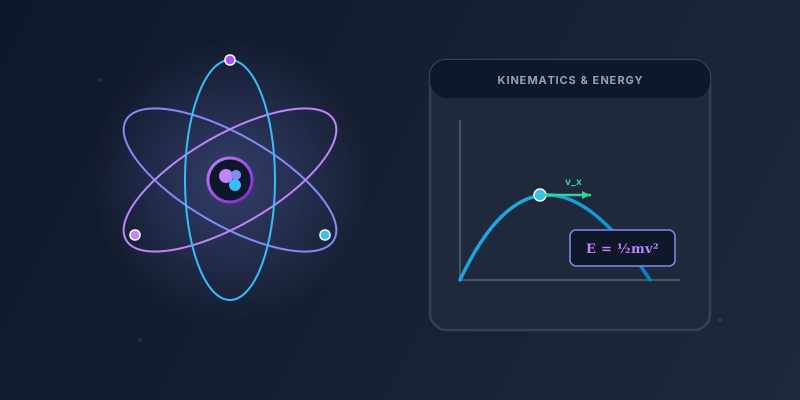
A velocity has a magnitude and a direction, and you can split it into perpendicular components: vx = v × cos(θ) and vy = v × sin(θ), with θ measured from the horizontal axis. A ball thrown at 50 m/s at 30° above horizontal has vx = 50 × 0.866 = 43.3 m/s and vy = 50 × 0.5 = 25 m/s. Going the other way, the magnitude is √(vx² + vy²) and the angle is the arctangent of vy ÷ vx. This is the same method used to resolve a wind into headwind and crosswind components in aviation, where the angle is measured between the wind and the track. Components can be added independently, which simplifies two-dimensional problems.
- Enter Vector Magnitude / Speed: Input your target parameter value.
- Enter Direction / Angle (degrees °): Input your target parameter value.
- Apply Formula: Calculate using
v_x = v × cos(θ) | v_y = v × sin(θ) | |v| = √(v_x² + v_y²). - Review Results: View exact computed answers, metrics, and worked mathematical proofs.
Need this calculator for your blog, publication, or client portal?
Get pre-formatted embed codes, Markdown citations for forums (Reddit/Whirlpool), or HTML anchor tags free.
Cite this Calculator
Are you using our calculation results for a university assignment, research paper, or academic report? Use the auto-generated citations below to accurately reference this tool in your bibliography.
MyCalculator.com.au. (2026). 2D Vector Velocity & Kinematics Calculator. Retrieved October 24, 2026, from https://www.mycalculator.com.au/calculators/physics/vector-velocity
MyCalculator.com.au. (2026) '2D Vector Velocity & Kinematics Calculator'. Available at: https://www.mycalculator.com.au/calculators/physics/vector-velocity (Accessed: 24 October 2026).
Frequently Asked Questions (FAQs)
What is the difference between speed and velocity?
Speed is a scalar quantity (magnitude only, e.g. 100 km/h), while velocity is a vector quantity (speed + direction, e.g. 100 km/h at 030°).
Embed 2D Vector Velocity & Kinematics Calculator on Your Site
Offer your readers, students, or clients interactive calculations. Fast, responsive, and 100% free with no login required.
Widget Customizer
Recommended for publishers & educational portals to provide source citation.
Authoritative Standards & Verified Reference Citations
Calculations and mathematical logic on this page are grounded in published statutory rules, regulatory standards, and official government data published by the following bodies:
Open government data, scientific datums, and public sector mathematical reference datasets.
Australia's national authority on physical, chemical, and biological metric measurement standards.
Dedicated Australian home loans, borrowing capacity, mortgage repayments & refinance modeling.