Lunar Phase Calculator
Determine the exact moon phase, illumination percentage, and lunar cycle timing for any date. Essential for astronomy, photography, and tidal planning.
Select a past, present, or future date to instantly calculate the corresponding lunar cycle phase.
% VISIBLE
Understanding the Lunar Cycle
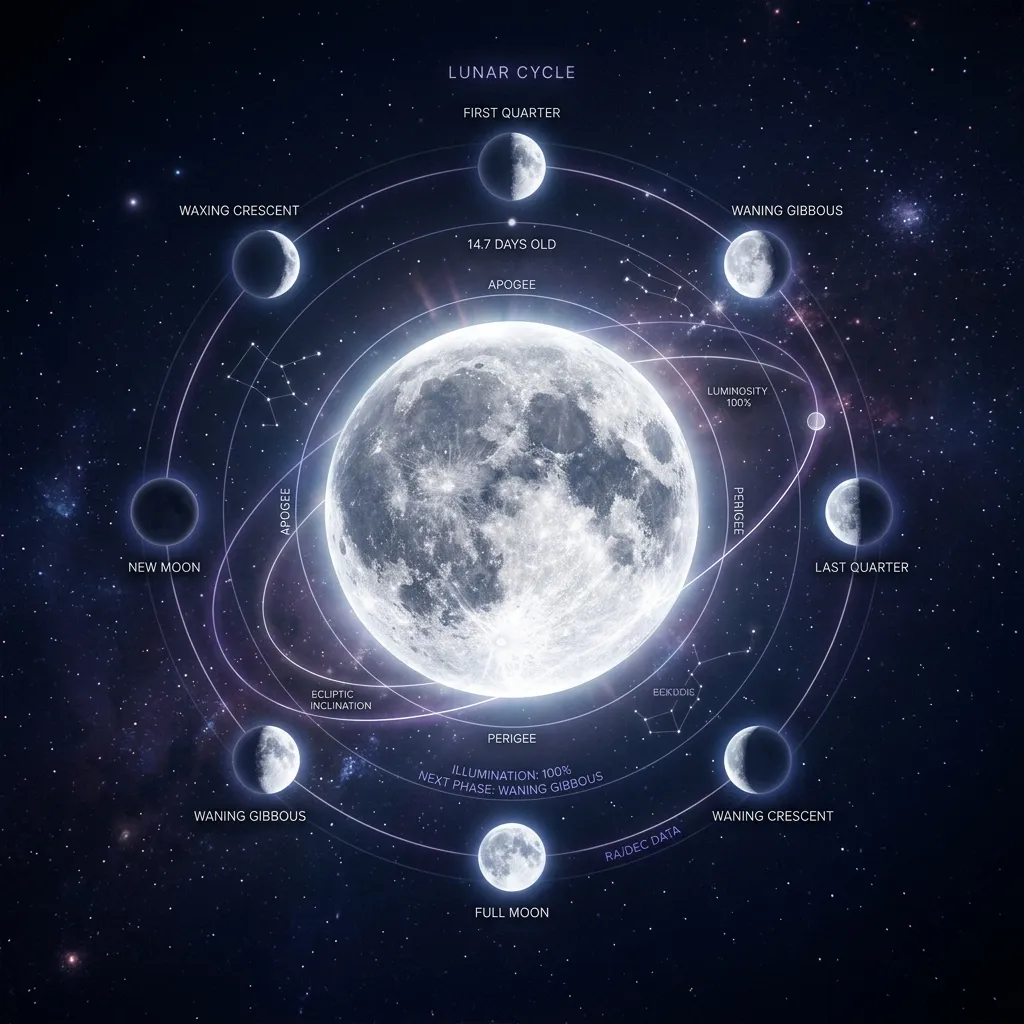
The Moon's phases are determined by its position relative to the Earth and the Sun. As the Moon orbits our planet over roughly 29.5 days, different portions of its sunlit half become visible from our perspective. This predictable mathematical cycle has been used for millennia to track time, predict tides, and plan agricultural harvests.
Our lunar calculator uses precise astronomical algorithms to determine the exact phase and illumination of the moon for any given date in the past or future.
Tides & Fishing
The gravitational pull of the moon is the primary driver of Earth's ocean tides. During a New Moon or Full Moon, the Earth, Moon, and Sun align, creating extreme "Spring Tides." These periods of high water movement are highly prized by anglers, as the shifting currents stimulate fish feeding behavior.
Astrophotography
For photographers looking to capture the Milky Way or deep-sky objects, moonlight is actually a hindrance. A New Moon (0% illumination) provides the darkest skies possible. Conversely, shooting the moon itself is often best during a Waxing or Waning Crescent, where the shadows along the terminator line reveal deep craters and mountains.
Frequently Asked Questions
How long does a full moon cycle take?
A full lunar cycle, from one New Moon to the next, takes approximately 29.53 days. In astronomy, this is known as a synodic month. Because our calendar months are slightly longer (30 or 31 days), the dates of moon phases shift slightly every month.
What is the difference between Waxing and Waning?
Waxing means the illuminated portion of the moon is growing larger each night, transitioning from a New Moon toward a Full Moon. Waning means the illuminated portion is shrinking, transitioning from a Full Moon back to a New Moon.